What does "fully-flexible" mean in a job advertisement


What is fully flexible?  Does it mean being able to fit under a pole at a sports event?   No.

Photo adapt. from Paul L Dineen, via Flickr.  CC by 2.0


You may see these words used in job advertisements or staff-wanted signs:  

  • Flexible hours
  • Flexible working
  • Fully-flexible

They all look similar, but they mean very different things. 


Flexible hours

If a job is advertised as having flexible hours, it usually means that it is for a certain number of hours each day or week, but they are happy to talk about when those hours are worked.  

For example, some people start later so they can take children to school first.  In some jobs, flexible hours may mean there are no set hours of work:  it’s up to you to work for long enough to get the job done.


Flexible working

A job with flexible working conditions is like one with flexible hours, but has even more options:  you may be able to work part time, or from home, etc.


Fully-flexible 

Many "staff-wanted" job advertisements say you must be fully flexible.

Usually in these jobs, the employer agrees to give you a certain number of hours work each week, but the days and hours that you work are different each week or month, and you need to be available to work at any day or time.  

For example, one week you may work from 10am to 2pm on Monday and Saturday, but the next week you work from 4-8pm on Thursday and Friday.

Fully-flexible jobs are often used when the number of customers can be change a lot.  For example in restaurants which are very busy during holidays, or fashion shops which have summer and winter sales.   Or they may have a lot of  staff who sometimes take time off, eg students for exams, and need flexible staff to be work extra hours at times.


Example of a staff-wanted advertisement,
which spells out what fully-flexible means


How do you know your hours in fully-flexible job?

Each week (or fortnight or month), you will get a rota or roster, telling you when you are scheduled to work.  

This might be put up on a noticeboard in work - or sent to you be email, WhatsApp,  etc.

Some jobs will let you swap shifts with other staff - and some won't.   


Are fully-flexible jobs a good idea?

Some people don't like fully-flexible jobs:  they think it is unfair, and discriminates against people - and that it's especially so when the job is only part-time, but the employee is expected to be available to work any-time.

And it's certainly true that not can be fully flexible, for example, people who need to get someone to look after their children during working hours.   

But fully-flexible jobs are good for people who don’t have commitments, and who want to get lots of hours or experience .  And some people (eg artists, musicians, students) like being able to ask for time off when other they are doing other things, and happy to work extra hours when they aren't.

The minimum wage is going up in January 2021


The Minimum Wage in the Republic of Ireland is going up on 1 January 2021 - as announced here.


What does this mean

The minimum adult hourly rate is increasing by 10c to €10.20 per hour.  It applies to  everyone who is age 18 or more, except apprentices, family members of employers, and people who work for companies that have a Labour Court exemption..
  • For people aged 19 the minimum hourly rate is 90% of the adult rate, so it becomes €9.18 per hour.
  • People aged 18  is 80% of the adult rate, so it becomes €8.16 per hour.
  • People aged less than 18:  for them, the minimum hourly rate is 70% of the adult rate, so it becomes €7.14 per hour.

This hourly rate is before tax, and it does not include tips, extra that you get for working overtime or at unusual times, pension contributions - if any of these apply, they must be paid on top of the minimum wage.   For example, if you are age 21 work for three hours, and your share of tips from the day is $20, then you must be paid at least  ( 3 x 10.20 ) + 20  = 30.60 + 20,   ie  $50.60

Do you have to be paid the minimum wage?

The law says that you must be paid at least the minimum wage, based on your age.

Employers can choose to pay you more than this, and  many employers do pay more than the minimum wage.


Minimum wage vs Living Wage

There are been recent news items about introducing a Living Wage in Ireland, with suggestions that the minimum wage should increase to $12.30 per hour.  

Recently the Taoiseach (Ireland's Prime Minister or top government leader) said that the government would "examine the introduction of a statutory living wage".  This means that they will think about it, but they have not made any promises yet.   

Some of the things to think about include how many hours people work for:  the Living Wage is calculated based on what it costs an adult to live in Ireland in a certain way, and assumes that you work for 39 hours per week.   But some employees choose to work less than full-time hours, and some jobs are never going to be full time.


Will everyone else's wages also increase?

Increases to the minimum wage doesn't apply to people who are already paid more - unless they have a contract which says  so, for example "Your hourly pay rate is the minimum wage plus 50c".

Sometimes other low-wage jobs do have wage increases at the same time  as the minimum wage increases, so they are still attractive to people who are looking for work.   However the Covid-19 crisis means this is less likely in 2021.


What to do if you are being paid less than the minimum wage

See what to do if you aren't being treated the right way at work for some suggestions.


Disclaimer

As always, this isn't legal advice.  Consult a lawyer if you need advice about a specific situation.

Minimum wage going up in February 2020


The Minimum Wage in Ireland is going up on 1 February 2020 - as announced here.

The minimum adult hourly rate is increasing by 30c to €10.10 per hour.  It applies to  everyone who is age 18 or more (except apprentices and family members of employers).
  • For people aged 19 the minimum hourly rate is 90% of the adult rate, so it becomes €9.09 per hour.
  • People aged 18  is 80% of the adult rate, so it becomes €8.08per hour.
  • People aged less than 18:  for them, the minimum hourly rate is 70% of the adult rate, so it becomes €7.07per hour.

Do you have to be paid the minimum wage?

The law says that you must be paid at least the minimum wage, based on your age.

Employers can choose to pay you more than this, and  many employers do pay more than the minimum wage.


Will everyone else's wages also increase?

Increases to the minimum wage doesn't apply to people who are already paid more - unless they have a contract which says they are linked   eg  "Your hourly pay rate is the minimum wage plus 50c".

But  it is likely that other low-wage jobs will have wage increases, so they are still attractive to people who are looking for work.


What to do if you are being paid less than the minimum wage

See what to do if you aren't being treated the right way at work for some suggestions.

Disclaimer

As always, this isn't legal advice.  Consult a lawyer if you need advice about a specific situation.

What to do when you aren't being treated the right way at work


Sometimes, things won't be right at work:  Employers don’t always follow laws.  You may be paid late, or your tax may not be wrong.  Other staff may be rude to you, or even hurt you.   You might be asked to do something unsafe, or illegal - or which you believe is wrong. 

There is no "right answer" about what to do when things like this happen. 

The list below has some suggestions about what you could do.   You need to decide what you will do, after thinking about:
  • What is going on
  • How much of a problem it is
  • What your employer will do if you complain, and
  • What other options you have.


Find out more

Often you need to start by finding out more about about the laws which apply:
  • If you think that your employer is paying less than the minimum wage, then you need to check if an exemption applies. So look up your employment contract, and the detailed rules from Workplace Relations.
  • If you are concerned about a health and safety issue, read the industry information provided by the HSA.
  • If your colleagues are treating you badly, this may be bullying - read here.
(These links are all for Ireland.  Many countries have similar laws.  Try googling "employment law" with your country-name to find informaiton for other places).


Knowing about the laws is helpful.  But some people don't mind breaking the law.   So you may also want to talk to your colleagues, or people who work in similar jobs to find out how things are for them. 

Or you could ask a question on a discussion forum like Boards.ie or AskAboutMoney.  (Your manager etc might read these too, so change some details so it's not obvious who is posting).

Also, think about what the consequences of an doing something about the problem might be.   Many employers will fix issues when you tell them   But some might just cut your hours or even fire you.


Decide what to do next

After you have the facts, you need to think about what to do next. 


Talk to your employer

Many employers are happy to fix problems without anyone else involved:  you just need to talk to them, and tell them what what is wrong. 

This doesn't always work.  But when it does, it is the fastest way of fixing problems, and it means that you and your employer will still get on well.


Involve the union

If you are a trade-union member, then a union delegate or staff member may be able to convince your employer to do the right thing. 

Unions can also give you information about "taking industrial action":  this means doing other things  like going on strike, or working-to-rule.   Often things like this aren't an option in places where jobs are advertised in shop-windows.   But it can be useful to tlak to the union about their experiences with your employer.

Workplace Relations

In Ireland the Workplace Relations Commission is a government agency that helps to protect employees' rights.
  • You can ask them a general question using this form or by phoning 059 9178990  / Lo-call: 1890 80 80 90 during office hours.
  • Find out about making a formal complaint to them is on this page.

Health and Safety Authority

In Ireland the Health and Safety Authority is a government agency that is responsible for making sure people are protected from work related injury and ill-health.

You can ask them a question or make a complaint using this form or by phoning their Workplace Contact Unit on  +353 1 614 7000 / Lo-call: 1890 289 389 between 9:00am and 12:30pm, Monday to Friday, or email them at wcu@hsa.ie


Do nothing - or find a better job

If your employer is treating you badly, or deliberately breaking the law, then it's probably not a great place to work.  Some people say that you should fight to get the problems fixed.  But others say that it's best to just find a better job, and that the best way to punish a bad employer is for no one to be willing to work for them.

Or, especially if you are leaving soon anyway,  you might just put up with how things are, knowing that  it's not for long.

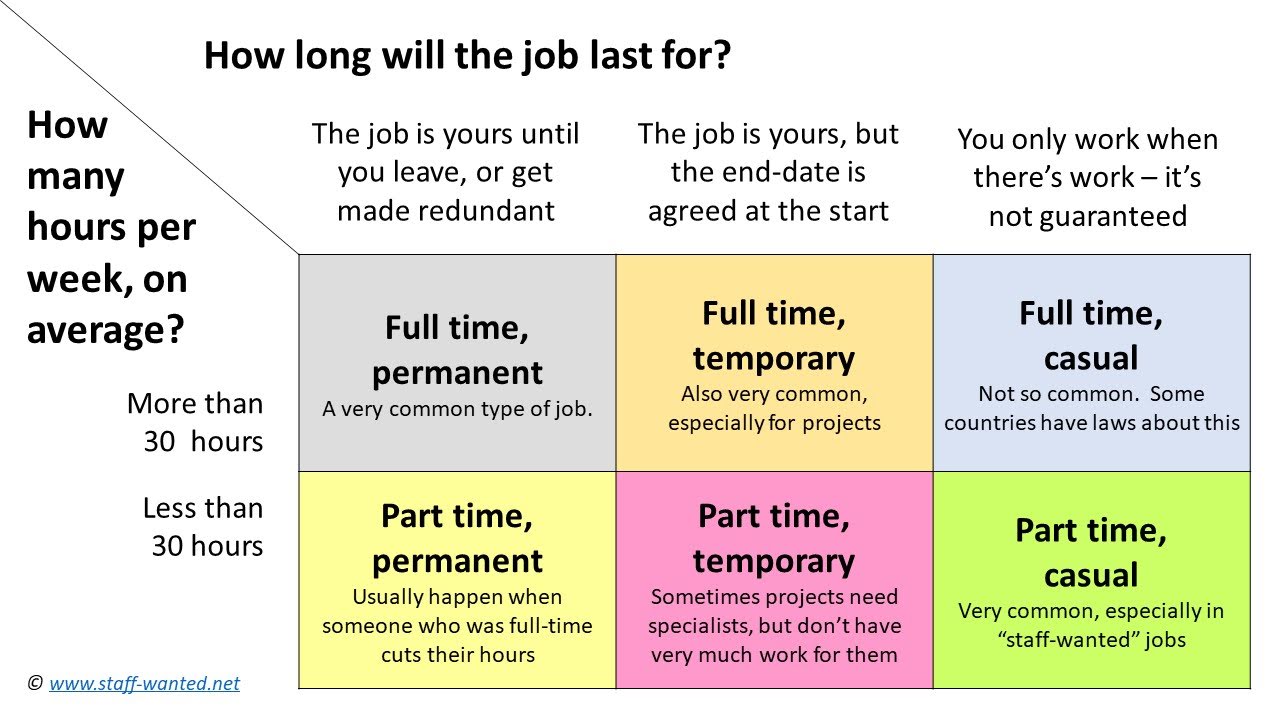
The difference between permanent and full-time jobs


People often mix up the words "permanent" and "full time" when they are talking about jobs.

It's important to understand what they mean, so you can be clear about what a job requirement is.   To do this, you need to think about two questions:
  • How long will the job last for:
  • How many hours per week - on average - do I work for?

How long will the job last?

If you work every week (except for agreed holidays) and there is no expected end-date, then your job is permanent.   Your employment contract may say it is a "contract of infinite duration" (in Ireland) or something similar (in other countries).

If you have regular work but know that it won't last forever, then your job is temporary. Another word for this is fixed-term.  Often, but not always, you know the expected end-date when you first start. 

Some reasons why a job might be temporary:
  • You are covering for someone who is away, eg on maternity leave or a career-break
  • You are doing a project (eg building a road, moving a shop, setting up a display )   
  • If the government or a charity is funding your employer, then your employer may say that the job will only last for as long as they keep getting the funding.
  • The job is based on seasons of the year, eg picking fruit, milking cows, or serving tourists.

If you are not guaranteed any work each week and are rostered or called in when you are needed, then your job is casual.    Another word for this is that you have have a zero-hour contract.   In Ireland, this became illegal in March 2019, unless the work really is casual.  Reasons why a job might be casual:
  • You provide cover when the regular staff are out sick:  when they're healthy, there's no need for you.
  • It's for a one off event that, which is unlike the rest of the year.   Eg a hotel in Galway needs very many extra wait-staff, bar-tenders and kitchen porters for a summer race meeting each year, but doesn't need them for the rest of the year.
  • You are only needed when unexpected things happen:  eg retained firefighters only get paid when they're called out.

How many hours do I work each week?

If you work for a certain number of hours each week, usually 30 or more (but it's different in some countries) , then your job is described as full-time.   Most people who have a full-time job only have one job.   You don't need to work exactly the same hours each week, or the same number of hours each day - just 30 or more hours in on average, every week.

If you work for a smaller number of hours each week, eg 8 or 15  or 25, then your job is part-time.   The idea is that you have enough "work time" free each week that you can do something else, for example another job, or study.

If you work for a different number of hours each week, and your employment contract doesn't say that you will get at least any hours, then your job is casual.


Putting this together

This diagram shows how job length and job hours combine to describe different work patterns:


No type of job is intrinsically better - although depending on your life-stage, some job-types might suit you better at the moment.   Eg   a person looking for a mortgage often wants a permanent job, while a student might like a casual job which gives lots of time off.


Some complications!

Real-life is sometimes complicated  Some people job-share, and work every second week.   Some jobs have shifts that are organised in different ways , eg 4 days on / 4 days off.

In these cases, to work out full-time vs part-time, you need to look at the average over three months:   add up all the hours you work, and divide the total by 13 to find out your hours /week.

The ideas of full-time and permanent don't look at whether your work the same days and hours, or if these can change either on a pattern (eg days one week and nights the next) or overall  (your 40 hours are different every week.    A job which is like this is described as shift-work - but there is no one way of describing the types of shifts.


A different way of thinking about full time

Some people have another way of thinking about full-time:  They say that the are full-time if they only work for one employer, and part-time if they have more than one job -  no matter how many hours they work at each place, or overall.

This comes from the idea that a full-time job keeps you totally busy, while a part-time one gives you time for other things, ie it only keeps you busy part of the time.

Working cash-in-hand in Ireland


When you are looking for a job, some people may ask you to work “cash in hand” or “under the table”.

This means that they will pay you in cash, not through a bank account.   Also, they won't deduct any tax, and usually will not give you a pay-slip, either.

At first, this sounds great:   you know exactly what you will earn, and everyone wants to pay less tax!

There are times when it’s the only practical way to work - for example, if you are using your own lawnmower to cut lawns, you only see each “employer” once a month for half an hour, they can ring up and cancel at any time, and you can do the work when you're ready (within reason) . But most jobs aren’t like this.

But there are some reasons why it's not-so-great too:   Before you agree to work “cash in hand”, you should understand what it means for your tax, welfare and employment rights.


Problems with working cash-in-hand

It’s against the law

The law in Ireland says that anyone who employs a person must:
  • Deduct tax from their wages and send this to the tax-department (who are called “Revenue”), and
  • Pay employer’s tax (called Employer-PRSI).

There are times when an employer doesn’t need to do this is if the job doesn’t meet Revenue’s “employee test”.  You can read about the "is this person an employee" test here, but.in short, if you are working:
  • in someone's building, 
  • at times they say, 
  • using their equipment 
  • being supervised by them 
then you are most likely are an employee, and your employer needs to be looking after the tax.

If you are working for someone and they don’t deduct tax and pay PRSI, then they are breaking the law. If Revenue find out about it, then they can be fined.

The law also says that you need to tell the Revenue any money you earn, and to pay the tax you owe on this. Most people don’t need to do anything about this, because their employers do it for them.

But if you work for an employer who isn’t sending your tax-deductions to Revenue, then you are responsible for telling them (this is called "declaring your income") and paying the tax. If you don’t do this, then you are breaking the law. And if Revenue find out about it later, then they may charge you a fine.


You won’t get social welfare

The second big problem with working under the table is that it can stop you being eligible to get social welfare.

The tax that is paid by workers and employers in Ireland includes Pay Related Social Insurance (PRSI).

For each week that you earn money and pay tax, you also earn one “PRSI Credit”.   (Some people call these “stamps”).

If you have enough PRSI-Credits, then:
  • If you lose your job, you can get Jobseekers Benefit
  • If you get sick, you can get Illness Benefit
  • If you have a baby, you can get Maternity Benefit
  • When you are old, you can get State Pension
  • and some other social-welfare benefits too
If any of these things happen, and you don't have enough PRSI credits, then you don't automatically get any welfare benefit.    You might be able to get some other social-welfare allowances, but they are a lot harder to get. And if your employer won’t give you a letter saying you were working there - so you won’t be able to prove you lost your job, which means you may not even get Jobseekers Allowance.

It may be impossible to get your other employment rights

Ireland has laws about your rights at work. These are about things like minimum wage, hours of work, being paid for the hours you work, jury duty, maternity leave, health and safety, equality, etc.

If your employer is breaking these laws, then you can ask the government to make them treat you correctly.

But if you are working cash-in-hand, then your employer can say that you don’t work for them at all - and you can’t prove that you do.

In the same way, if you have an accident at work and your employer says that it’s your fault because you were trespassing - you can’t prove that you were supposed to be there.


What do do

If someone asks you to work cash-in-hand or under-the-table, then you need to weigh up the costs and benefits, and decide if it’s worth taking the risk.


In Ireland, people who earn under approx €18,000 in a year don’t have to pay very much tax anyway, - so some decide that for the amount of tax they save, it's just not worth the risk.

If you do decide to take do it for short time, then make sure you don’t stay in the job for long: The longer you stay there, the more time you are not earning “stamps” and so the more chance you will have a big problem if company eventually closes - or even several years later.

And, of course, either way you should make sure that you are declaring your income to Revenue, and paying the right amount of tax.


Note:  the Staff-Wanted network are not lawyers or accountants.  This is very simple description of the issues   If you need legal or tax advice, please consult a professional.

Institutes of Technology in Ireland which teach professional cooking / chefing


In general, at third-level in Ireland:
  • Universities offer provide study in academic and professional-level subjects
  • Institutes of Technology offer study and training in practical / technical subjects, leading to degree and diploma qualifications
  • Regional Education and Training boards offer courses in practical subjects, leading to certificate qualifications.
Most professional cooking course are taught in institutes of technology (IT's).

Not every county or area has its own IT.   The IT's don't all have the same courses, and they don't all teach chefs / professional cooking.  And they are all organised differently, so the name of the department or school which teaches chefing is different, too.

Below is a list of the ITs that do have courses for people who want to become chefs, and the name of the school or department which runs these courses.


Changes to employment laws in Ireland in March 2019


Some new laws about employee rights apply from 4 March 2019 - thanks to the Employment (Miscellaneous Provisions) Act 2018,

This is a plain English list of the main changes.

If you need more information, see a full explanation of the changes here.

Please note:  the Staff-Wanted network aren’t lawyers - and this is very simple description of the changes.   If you think there is a problem with these new laws and your job, then you need to check the details with a lawyer: do NOT rely on this article.)


What does the new law say

Most of the changes are for people who work part time, temporary or casual jobs - exactly the ones that are listed on Staff-Wanted.

Very roughly:

  • You must get a written contract within  five days
  • Zero hours contracts aren't allowed  (but there are exceptions)
  • If you're called, you should get at least three hours pay
  • If you work more hours than you contact says for 12 months, then your should be changed.
  • Minimum wage is basedon your age, not working time after age 18.


Read on for more details about how these rules will work.


Where to find government jobs in Ireland

Although there are some centralised recruiting services, there is no one place to look for government jobs in Ireland.

This is a list of places that government jobs may be advertised - and many are also advertised in the same way as non-government jobs.
  • Public Appointments Service (PAS)
    Officially "the centralised provider of recruitment, assessment and selection services for the Civil Service, Local Authorities, the Health Service Executive, An Garda Síochána and other public bodies" - this website lists many, but certainly not not all, public-service jobs.
  • City and county councils all list jobs on their own website:  there is one attempt at a central website (http://www.localgovernmentjobs.ie/) - but it only has jobs from a few local authorities.
  • Regional education and training boards - again, there is no central website for jobs in these bodies.   You need to check each region separately.
  • ActiveLink - produces a weekly bulletin of social care volunteering and paid work vacancies.  Many of these jobs are government funded.  People who work for them are often paid on government pay-scales - but are employed by charities / non-government-organisations etc, not the government. 


Happy Birthday!

We're a year old!


The Staff Wanted network has been sharing jobs advertised in "shop windows" in Galway city for a year this week- so it seemed like a good time to celebrate, and look at what's been achieved so far.


To date ...

We've listed 813 jobs (more coming later today), got 329 followers on Facebook and 155 in Twitter.   Our home page has been viewed 38,437 times - and we've lost count of the number of views of individual jobs.   A blog has been started, and lots of ideas for useful posts have been written down.


Where did Staff-Wanted come from?

The idea was dreamed up back in 2010, when Ireland was deep in a recession, professionals were expected to work for free on "Job Path", and some hospitaility employers were offering one-week unpaid "job trials" after which no one was ever hired.

An unemployed inner-city-based IT worker was learning about websites, and wondered about using one to share the job-advertisements around the city with people who couldn't afford to travel in to job-hunt every day - and to avoid being ripped of.  A few friends tossed the idea around, the first website was set up, and a few job-adverts were even posted.   But the time wasn't quite right, gathering job-info was slow, and some paid work came up to keep people busy.

Fast-forward to late 2017, and suddenly the time, skills and opportunity came together:  the website was re-vamped, policies revised, and the much-improved mobile phone cameras and Facebook gave the whole idea a boost.


What next?

A few ideas are in the works.   It would be great to take the idea to another location, and possibly work with a community group or job-club gathering job listings.   Some "how to" tools are being developed, to help people who work in jobs that are typically advertised in "shop windows" - and people who employ them.


The basics will stay the same though
  • Only jobs which could be advertised by hanging a sign outside the workplace: 
  • No scraping from other jobs websites or Facebook pages - this isn't a replacement for career websites
  • Genuine, legal, paid-work vacancies only
  • No commission selling
  • No unpaid work-experience programmes.

In the meantime ... let's celebrate!


Will the VAT rate increase cause job loses?

In 2018, the Irish government decided that the Value Added Tax (VAT) rate for the tourism and hospitality sector would increase from 9% to 13.5%, effective from 1 January 2019.

Listening to the reaction of some pub owners, you could be left thinking that this 50% increase in the rate will be dreadful for businesses, and cause lots of job losses.

Should people working in restaurants and pubs should be worried about their jobs?   Will staff be laid off, or have their hours reduced?   Will businesses stop hiring new waiting staff, bar-tenders and chefs in 2019?

No one will know for certain until the year is well under way. 

But it looks unlikely

Yes, there will be some price increases, probably between 20 and 25c per pint (see below for an explanation of this).   Some customers will be annoyed, and January might be a little drier than usual while they get over this.   Price increases in expensive venue will be proportionately higher:  a meal that is €100 now will likely increase to €104.50.  But probably the effect will be small, and barely notice by most people employed in the hospitality industry.

That said, maybe some jobs which would have been filled in early January will be delayed a little - but this is likely to be due to worries about the effect of Brexit, than a minor change to the VAT rate.   Some people will have their hours - but this happens most years in the winter season.


Working out the effect of the VAT increase on the price of a pint

Imagine a pint that costs €5.00 in 2018.   (It's easier to work with a nice round figure).  Roughly speaking this is made up of:
  • The cost of the beer (including profit for the brewery and distributor, and brand-marketing), 
  • The excise tax on it, 
  • The cost of getting it to the pub where it's served (including profit for the transport company)
  • The cost of serving it (including the building rental, heating, lighting, insurance, the staff time, washing the glass it's served in - and profit for the publican).
Once these parts are added together, a "value added tax" (ie VAT), is added to get the overall price that a customer pays.   (Similar to sales-tax in some other countries).
  • If the VAT rate is 9% then €5 is made up of around €0.41 of VAT, and €4.59 of pre-tax-price.
  • When the VAT rate is 13.5%, the pre-VAT price is still €4.59, the VAT is €0.61, taking the likely final price to €5.20 or €5.25.


How much a pint of beer will cost in 2019, after the tax rate increases:   a pint that now costs €4.50 will likely cost €4.70.

The minimum wage is going up on 1 January 2019


The Minimum Wage in Ireland is going up on 1 January 2019.

The minimum adult hourly rate is increasing by 25c to €9.80 per hour.  It applies to  everyone who does not fit into these categories:
  • People aged 19+ and who have worked(*) for less than two years since they turned 18:  For them, the minimum hourly rate is 90% of the adult rate, so it becomes €8.82 per hour.
  • People aged 18+  and who have worked(*) for less than one year since they turned 18:  For them, the minimum hourly rate is 80% of the adult rate, so it becomes €7.84 per hour.
  • People aged less than 18:  for them, the minimum hourly rate is 70% of the adult rate, so it becomes €6.86 per hour.
(*)  Any paid work after turning 18 counts:   It doesn't need to be full time, or in the same industry.  These rules are set out in the National Minimum Wage Act 2000, which is a law passed by the Irish government.   If you think that parts of this law are unfair - for example, that work experience before you turn 18 is not counted - then you should discuss this with your local TD, or political party.


Do you have to be paid the minimum wage?

The law says that you must be paid at least the minimum wage.   Employers can choose to pay you more than this - even if you are under 18 or have not been working for very long.   Many employers do pay more than the minimum wage.


Will everyone else's wages also increase?

An increase to the minimum wage doesn't apply to people who are being paid a higher rate - unless they have a contract which says they are linked   eg  "Your hourly pay rate is the minimum wage plus 50c".

However over time, it is likely that other low-wage jobs will have wage increases, so they are still attractive to people who are looking for work.


What to do if you are being paid less than the minimum wage

If  you are getting less than the minimum wage, then the first thing to do is to check:
  • Is there any exemption for your job (eg for trainees, apprentices, or employers in financial difficulty), or
  • It is because of the way your hourly rate is calculated.   (In some jobs, there are allowances or particular times that are or aren't included).
You can find more details about this here on the Citizen's Information website.

If you are not being paid correctly, you can choose what to do next.   Some options are:

Talk to your employer

Sometimes employers make mistakes, don't know about the increased rates, or the amount of work experience that you have.   It is usually best to ask them about the problem first and give them a chance to fix the problem, before getting anyone else involved.

Talk to your union

If you belong to a union, then a union delegate or staff member can talk to your employer about the minimum wage rate, and how it applies to you.   They will also know if your employer regularly pays people less than they should, and what to do about it.

Talk to Workplace Relations

The Workplace Relations Commission is a government agency that helps to protect employees' rights. They can investigate and may do various things to help convince your employer to pay you correctly - anything from a gentle reminder letter or phone-call, right through to a full audit of your workplace and/or taking your employer to court.
  • You can ask them a general question using this form or by phoning 059 9178990  / Lo-call: 1890 80 80 90 during office hours.
  • Find out about making a formal complaint to them is on this page.

Do nothing - or find a better job

If someone is paying you less than the minimum-wage, then they are breaking the law.

f they keep doing it, even after they know about the law, then probably it's not a great place to be working:  Many people would say that you should focus on finding a better job, with an employer who is not going to behave like this.


Disclaimer

As always, this isn't legal advice.